By Amanda Eaken
Ten years ago last month, San Francisco proudly became the second city in the United States to adopt Vision Zero, an ambitious pledge to end all serious and fatal traffic crashes. Since I joined the SFMTA Board of Directors in 2018, I have been laser focused on what it will take to get to zero.
Like many of you, I feel very strongly that this must be a top priority for our city. I see the ability to walk, bike, drive, scoot, roll or take transit safely, without fear of harm, as a basic right and freedom that people should expect in our city. A basic right just like turning on the tap and expecting that the water is safe for you to drink — something you just assume the government will take care of for you. And, as I affirmed at the Mayor’s Vision Zero press conference, I share in the feelings of rage, powerlessness and grief whenever I learn that anyone is injured or killed in traffic violence on our streets.
But it wasn’t until recently, at the SFMTA Board workshop in January, that I realized that Vision Zero is not, actually, our vision. Of course no one should die or be injured in traffic on our streets. Great cities are for people, not cars. But we could reach Vision Zero and still fall far short of the city I think we want to be.
Let me unpack this a bit further. I think safety is actually the floor, it’s the minimum. Safety should be a basic right of people trying to get around the city. But as we’ve seen on Slow Sanchez Street or the Great Highway over the last few years, streets can be so much more than just safe. They can be places that uplift and elevate people. I know on some of my toughest days, a walk on JFK Promenade is pure therapy. More often than not these days I run into someone I know out there, and it warms my heart to see so many people enjoying themselves. I love seeing the irrepressible smiles on parents’ faces as they teach their very small family members to safely ride a bicycle, or hearing friends laughing as they lounge in the yellow Adirondack chairs.
Our streets can be blank canvases for local artists, places for communities to express and celebrate their unique identities and histories. As a member of the NOPA community, I recently learned that the San Francisco Parks Alliance is going to bring art to some of our neighborhood Slow Streets. I was asked to fill out a survey about which elements of our community’s history best express our identity, and should be featured in the artwork. I highlighted the Black churches in our neighborhood, NOPA Corner Market, the Panhandle, the University of San Francisco and Divisadero Street.
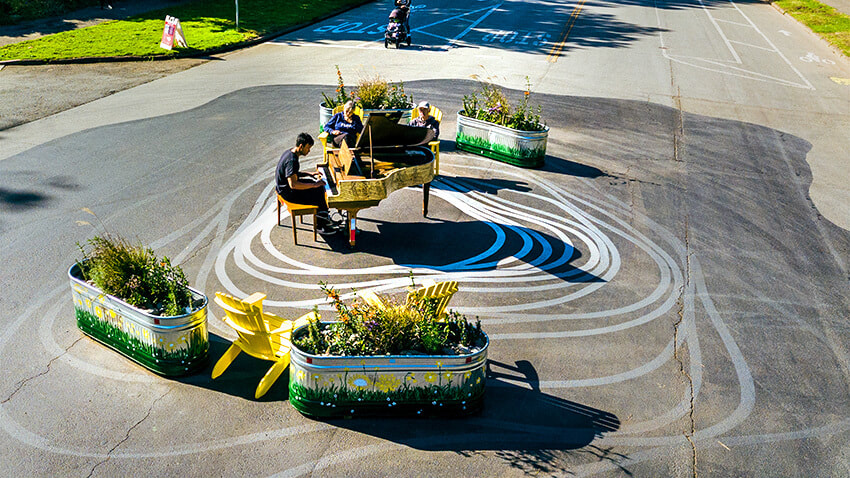
The community gathering space of JFK Promenade has a soundtrack of its own with pedestrians passing by live, public music and art. Credit: Paint the Void
Great streets should, in my view, create opportunities for joy and delight. Streets can be places that enable play and silliness like the ping pong table at 8th Avenue or the white wobbly chairs kids love to spin around in. They can be community gathering spaces that help to create the spontaneous moments of connection that are why we all live in a city to begin with.
Whenever I ride my bike down JFK promenade on a Sunday and hear the community sing-along around that wonderful old and warped Rec and Park piano, or stroll down Great Highway, take a seat on one of those orange metal chairs and soak in some live jazz with the spectacular Pacific Ocean behind me, I am so moved. This, I think to myself, THIS is the kind of city I want to live in – where the government partners with communities to create wonderful spaces that provide more opportunities for joy and connection.
COVID changed all of our lives, for some of us permanently. I observe — and have experienced — that some of us are still quite isolated, that people are craving more connection. Streets can be places for community members to come together, to combat what our Surgeon General is calling a national epidemic of loneliness.
So as we look to the next ten years of the essential work of making our streets safe, what some are calling Vision Zero 2.0, I want us to pause and ask ourselves whether Vision Zero is the extent of our vision. Vision Zero means nothing tragic or unacceptable happens. But I want to flip that around. Because every day, in thousands of ways, big and small, I hope our streets can do more than just prevent tragedies. I hope our streets can be places people can experience moments of joy and delight on their commutes. Where they can cross the street with comfort and dignity, rather than feeling that they have no option but to become defensive, anxious pedestrians, constantly on the lookout for cars turning right on red creeping into the crosswalk or drivers looking down at their phones rolling through a stop sign. I want our city to be a place that is safe for children to travel independently. When we make these important policy decisions about whether to restrict certain movements of vehicles, I want us to think about our kids — it’s their city too.
So please: join me in both recommitting to and re-envisioning Vision Zero over these next months.
I created the Vision Zero subcommittee of the SFMTA Board of Directors because I wanted us to have a space where we can sit around a table together, to share ideas, to jointly problem-solve, to co-create the city we all want to live in. Bring your vision, passion, creative thinking, as we embark on the journey to chart a course for the next ten years.
The next meeting is Tuesday June 11th at 1 p.m. at 1 South Van Ness Avenue, or you can always attend my virtual office hours on Mondays at 4 p.m. during the first and third weeks of the month.
Amanda Eaken is the Chair of the SFMTA Board of Directors which provides policy oversight for the safe and efficient movement of people and goods in San Francisco in accordance with the San Francisco Charter and the Transit-First Policy. This includes the San Francisco Municipal Railway (Muni), automobiles and trucks, taxis, bicycling and walking. The SFMTA Board of Directors also serves as members of the San Francisco Parking Authority. The SFMTA Board of Directors generally meets on the first and third Tuesday of each month at 1:00 pm. in Room 400, City Hall unless otherwise noted. Members of the public can attend or view meetings on SFGovTV2.
Published April 10, 2024 at 12:57AM
https://ift.tt/LHefmXn
Comments
Post a Comment