
It’s Electric! Battery Buses Then and Now

It’s Electric! Battery Buses Then and Now
By Jeremy Menzies

Battery-electric buses and cars have been hitting the streets around the nation in recent years, and here in San Francisco, the SFMTA is currently running a pilot program to test battery powered buses across the system. The pilot analyzes not only the buses themselves, but also how the technology works in the real world of stop-and-go traffic and hill-climbing.   

Surprising as it may seem, this pilot program is not the first time battery electric buses appeared on the streets of SF. Here’s a look back at one test that took place over 50 years ago. 
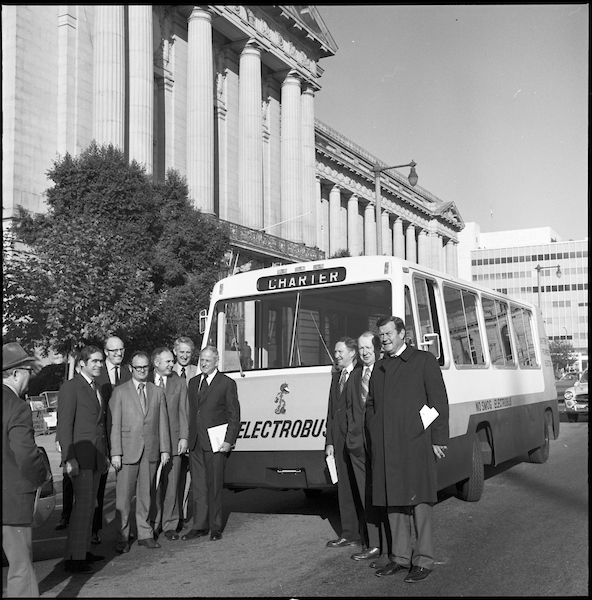
A black and white photo of an early-stage Electrobus with people posing for a photo around it.

While battery electric vehicles date back nearly 200 years to the 1830s, it took over a century for them to see widespread commercial success due to the limitations of the battery technology. 

One of the first times Muni tested a battery-powered bus was in November 1972.  Dubbed the “Electrobus”, this small vehicle was tested on the 39 Coit route up Telegraph Hill. This route has historically been served by shorter than normal buses due to the tight turns and steep grades up the hill. 
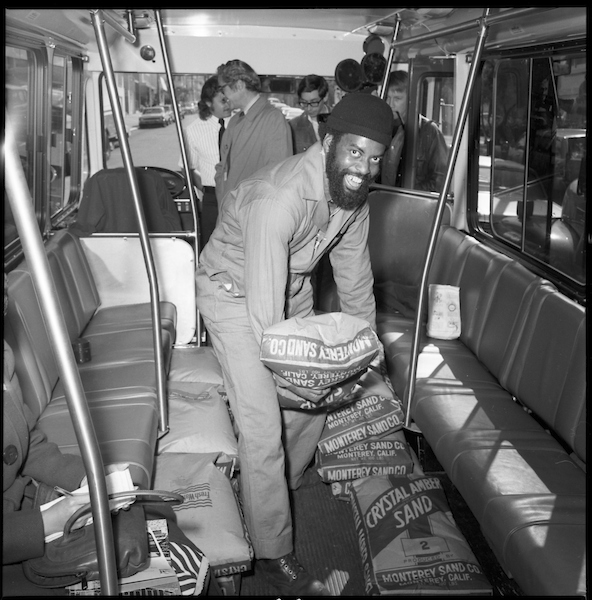
A black and white photo of a person loading sandbags into a bus.

Loaded with sandbags to simulate the weight of passengers, the Electrobus climbed up the hill to the Coit Tower parking lot just like its gas-powered counterparts. While this bus never went into service, it was one of a handful of “alternative” buses Muni explored in the early ‘70s, including a steam bus and a flywheel-powered bus. 
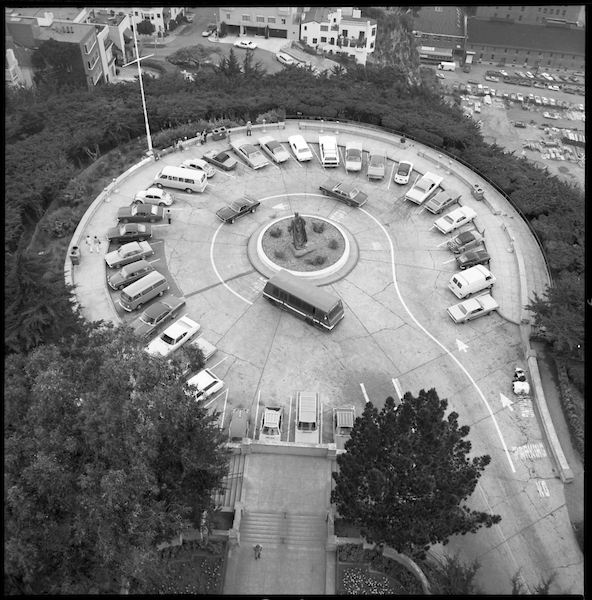
A black and white overhead photo of a circular parking lot full of cars and buses and surrounded by trees.

Today, the SFMTA is testing battery electric buses from four different manufacturers to see what the vehicles can do and to work out possible kinks in adopting the technology on a large scale. 
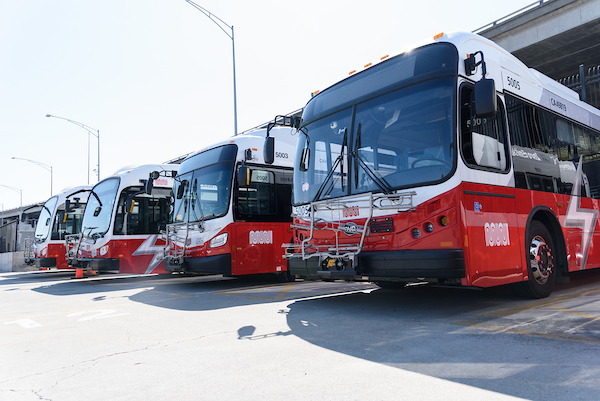
A bus yard with a close up shot of several parked Battery Electric Buses that are red and white.

These buses have been running on some of the city's hardest routes for months, from long stretches along the 9 San Bruno line to the steep hills of the 22 Fillmore, to determine their viability as an alternative to our hybrid-diesel buses.
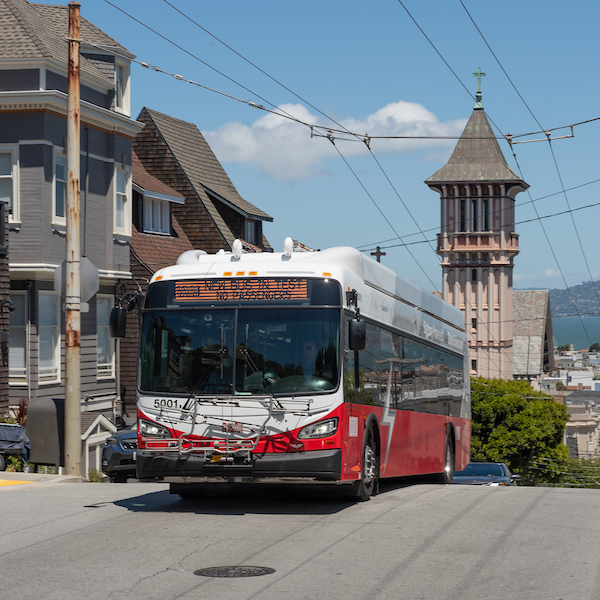
A red and white battery-electric bus climbs a steep street in San Francisco.

Muni already operates the greenest fleet of any city in North America. Pollution from Muni makes up less than 0.001% of citywide emissions, while 30% of the city’s greenhouse gas emissions come from private vehicles. Riding transit is a sustainable way to travel, and we’re committed to our efforts to achieve a 100% zero-emissions transit fleet. Alongside trolley buses and other emerging technologies, battery-electric buses will play a critical role in a cleaner, greener future for Muni and all of San Francisco. 


Published November 30, 2023 at 11:17PM
https://ift.tt/IwJsmoT

Comments

Popular posts from this blog

Help Make Muni Safe for Everyone

Help Make Muni Safe for Everyone By Mariana Maguire New Muni “no harassment” symbol The safety of our customers and staff is a top priority for the SFMTA. That is why we are launching MuniSafe – a campaign to increase reporting of gender-based harassment through recently expanded incident reporting options. If you experience or witness an incident, help us make MuniSafe by reporting it using the Muni Feedback form at SFMTA.com/MuniFeedback, the 311 mobile app or by calling 311. Non-English speakers should call 311 for language-assisted reporting. Gender-based harassment takes many forms, affects many people and is absolutely not tolerated on Muni. Survivors should report incidents to the San Francisco Police Department if they feel comfortable doing so. By also reporting incidents directly to the SFMTA, you will help us track events that occur in our system so we can build better safety responses and direct resources to reduce gender-based harassment. New car cards that will be...

L Taraval Improvement Project “Segment B” Geared Up for Early 2022

L Taraval Improvement Project “Segment B” Geared Up for Early 2022 By Stephen Chun Over the summer, we shared the good news that the  first segment  of the  L Taraval Improvement Project  was  completed on schedule and within budget.  A notice to proceed for the next phase of work, Segment B was issued last week to NTK Construction. Project staff is now gearing up for work slated to begin in January 2022.   What is the L Taraval Improvement Project?  The L Taraval Improvement Project is a multi-agency collaboration partnered with the San Francisco Public Utilities Commission and the Department of Public Works to improve and upgrade the aging infrastructure. The project will make pedestrian crossing safer, increase accessibility, improve transit reliability, rehabilitate water and sewer infrastructure, enhance landscaping and replace road pavement along the L Taraval line....

Do exercise to keep fit

Health is wealth