
Five Years of Data Show: Our Street Safety Projects are Making a Difference

Five Years of Data Show: Our Street Safety Projects are Making a Difference
By Julia Malmo

Ever wonder about the effectiveness of projects after they go into the ground? Us, too!  

That’s why, in 2017, we launched the Safe Streets Evaluation Program to help project teams understand whether a transportation safety project’s design is effective, and where there might be opportunities to adjust the design if not. Project evaluation data can also be combined across projects to help the SFMTA track the effectiveness of a certain type of safety improvement, which can in turn streamline the design of future projects. The Safe Streets Evaluation Program helps us work towards achieving Vision Zero, an initiative to prioritize street safety and eliminate traffic deaths in San Francisco.  

This week, we’re looking back on five years of data gathered through our Safe Streets Evaluation Program with the “2022 Safe Streets Evaluation Summary,” an interactive website summarizing the results of 18 bicycle, pedestrian and traffic safety projects implemented since 2017. 

Each of the 18 projects evaluated in the summary report added significant safety upgrades to the streets. Some introduced vehicle travel lane removals (road diets), separated bikeways, separated bike signals, or left-turn traffic calming devices. Others brought general improvements for pedestrians at intersections including pedestrian signal improvements, daylighting (red zones at intersections) and upgraded crosswalks. For every project, the SFMTA drew on a wide range of data—from project-specific observations, to police reports, to speed data—to create a comprehensive view into its’ effectiveness. 
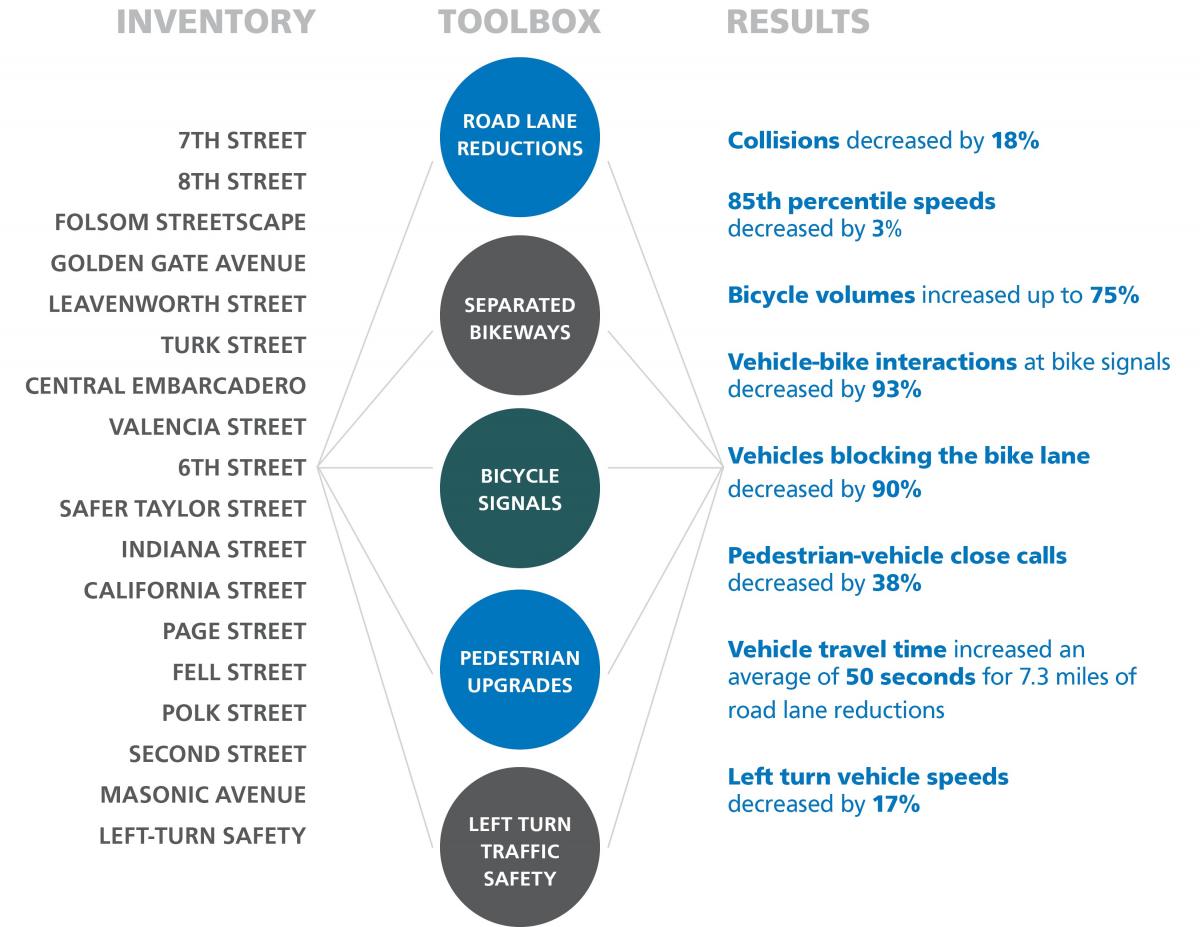
An infographic displaying the project names, key design element, and results. In the lefthand column, under “Inventory” the following projects are listed: 7th Street, 8th Street, Folsom Streetscape, Golden Gate Avenue, Leavenworth Street, Turk Street, Central Embarcadero, Valencia Street, 6th Street, Safer Taylor Street, Indiana Street, California Street, Page Street, Fell Street, Polk Street, Second Street, Masonic Avenue, Left-Turn Safety. In the center column, under “toolbox,” the following elements are listed: Road lane reductions, separated bikeways, bike signals, pedestrian upgrades, left-turn traffic safety. In the righthand column, under “results”, the following findings are listed: Collisions decreased by 18%; 85th percentile speeds decreased by 3%; bicycle volumes increased up to 75%; vehicle-bike interactions at signals decreased by 93%; vehicles blocking the bike lane decreased by 90%; pedestrian-vehicle close calls decreased by 38%; vehicle travel time increased an average of 50 seconds for 7.3 miles of road lane reductions; left turn vehicle speeds decreased by 17%

The evaluation report indicates that the SFMTA’s safety tools are working together to create safer environments for all modes of transportation on city streets. 

You can dig into the whole set of outcomes on the website, but here are some highlights:  

  • Within the projects evaluated, annual collision rates decreased by 18%  

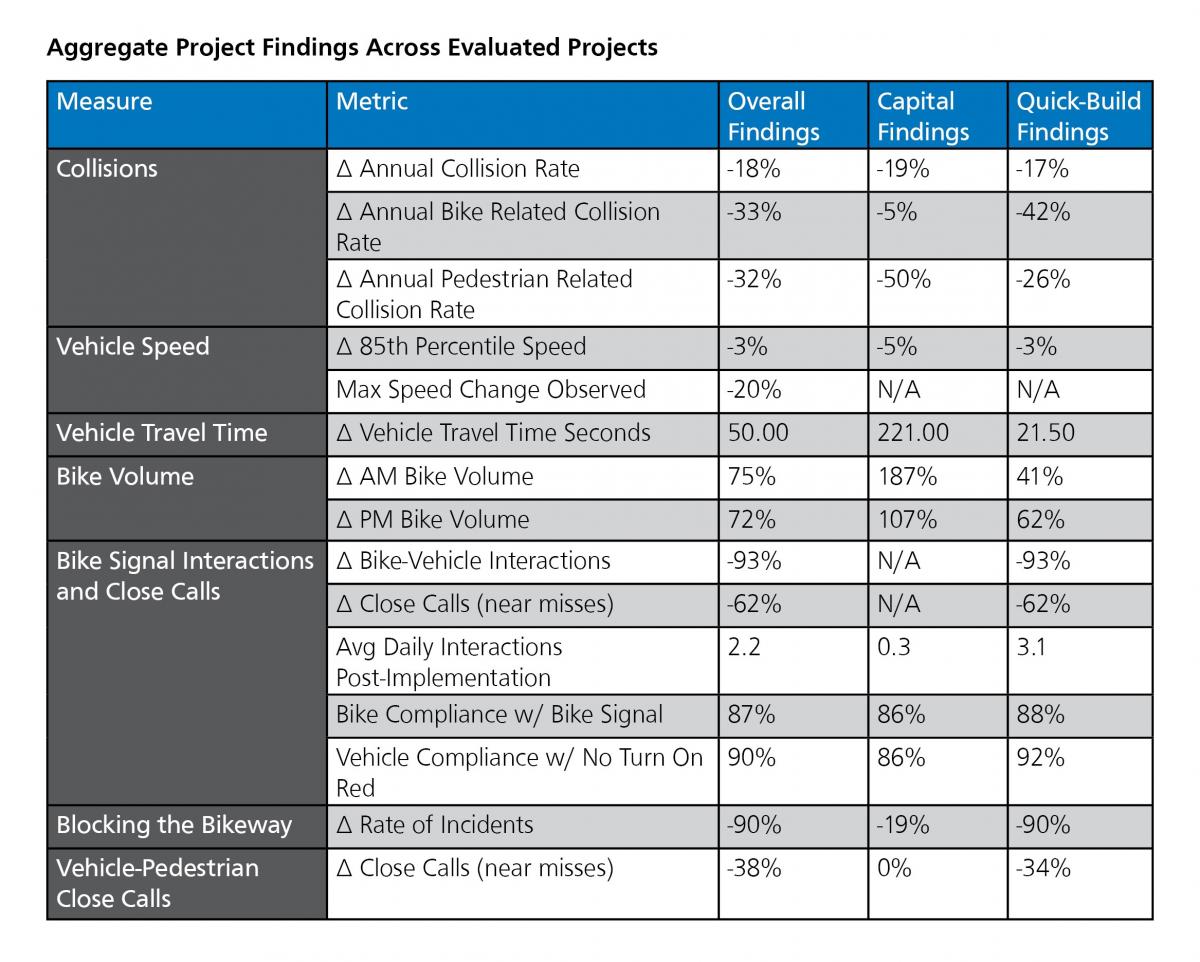
  • Bicycle-related collision rates decreased by 33% and pedestrian-related collision rates decreased by 32%   

  • Bicycle volumes on streets that received bicycle improvements increased up to 75% in the morning peak (8 AM to 10 AM) commute times, with similar growth in the afternoon/evening peak (4 PM to 6 PM) commute times.   

  • Thanks to protected bikeways, the rate of incidents of vehicles blocking the bike lane decreased by 90%.   

  • Close calls or near misses between pedestrians and drivers decreased across evaluated projects by 38%.  

  • Several projects in under-served communities such as the Bayview and Tenderloin are helping to address historic inequities and under-investment in these neighborhoods.   A table titled “Aggregate Project Findings Across Evaluated Projects”. At the top of the table, a blue bar lists out the column titles: Measure; Metric; Overall Findings; Capital Findings; Quick-Build Findings. In the Collisions section, the following sub-categories are evaluated. For Annual Collision Rate: Overall findings show an 18% reduction; Capital Findings show a 19% reduction; Quick-Build Findings show a 17% reduction. For Annual Bike-related collision rate: Overall findings show a 33% reduction; Capital findings show a 5% reduction; Quick-Build findings show a 42% reduction. For Annual Pedestrian Related Collision Rates: Overall findings show a 32% reduction; Capital findings show a 50% reduction; Quick-Build findings show a 26% reduction. In the Vehicle Speed section, the following sub-categories are evaluated. For 85th Percentile Speed: Overall findings show a 3% reduction; Capital findings show a 5% reduction, and Quick-Build Findings show a 3% reduction. For Max Speed Change Observed: Overall findings show a 20% reduction, and no data is present for either Capital Findings or Quick-Build Findings. For Vehicle Travel Time/Vehicle Travel Time in Seconds: Overall findings show 50.00; Capital Findings show 221.00; Quick-Build Findings show 21.50. For the Bike Volume section, the following sub-categories are evaluated. For AM Bike Volumes: Overall Findings show a 75% increase; Capital Findings show a 187% increase; Quick-Build findings show a 41% increase. For PM Bike Volumes: Overall Findings show a 72% increase; Capital Findings show a 107% increase; Quick-Build Findings show a 62% increase. In the Bike Signal Interactions and Close Calls section, the following sub-categories are evaluated. For Bike-Vehicle interactions: Overall findings show a 93% reduction; Capital findings show no data; Quick-Build findings show a 93% reduction. For Close Calls (near misses): Overall findings show a 62% reduction; Capital findings show no data; Quick-Build findings show a 62% reduction. For Average Daily Interactions Post-Implementation: Overall Findings show 2.2; Capital Findings show 0.3; Quick-Build Findings show 3.1. For Bike Compliance w/ Bike Signal: Overall findings show 87% compliance; Capital Findings show 86%; Quick-Build Findings show 88% compliance. For Vehicle Compliance w/ No Turn On Red: Overall findings show 90% compliance; Capital Findings show 86% compliance; Quick-Build findings show 92% compliance. In the Blocking the Bikeway section, Rates of Incidents was evaluated. Overall Findings show a 90% reduction; Capital Findings show a 19% reduction; Quick-Build Findings show a 90% reduction. In the Vehicle-Pedestrian Close Calls Section, Close Calls (near misses) were evaluatd. Overall Findings show a 38% reduction; capital findings show a 0% reduction; quick-build findings show a 34% reduction
The Safe Streets Evaluation team will continue to think creatively about how to build on the evaluation work and use it to inform our current and future projects, programs, and practices through developing a publicly accessible database of all Safe Streets Evaluation data and finding better ways to evaluate project outreach efforts. 

View the 2022 Safe Streets Evaluation Summary 

Learn more about the SFMTA Safe Streets Evaluation Program: SFMTA.com\safestreetsevaluation 


Published November 08, 2022 at 04:26AM
https://ift.tt/yinHPS9

Comments

Popular posts from this blog

Help Make Muni Safe for Everyone

Help Make Muni Safe for Everyone By Mariana Maguire New Muni “no harassment” symbol The safety of our customers and staff is a top priority for the SFMTA. That is why we are launching MuniSafe – a campaign to increase reporting of gender-based harassment through recently expanded incident reporting options. If you experience or witness an incident, help us make MuniSafe by reporting it using the Muni Feedback form at SFMTA.com/MuniFeedback, the 311 mobile app or by calling 311. Non-English speakers should call 311 for language-assisted reporting. Gender-based harassment takes many forms, affects many people and is absolutely not tolerated on Muni. Survivors should report incidents to the San Francisco Police Department if they feel comfortable doing so. By also reporting incidents directly to the SFMTA, you will help us track events that occur in our system so we can build better safety responses and direct resources to reduce gender-based harassment. New car cards that will be...

L Taraval Improvement Project “Segment B” Geared Up for Early 2022

L Taraval Improvement Project “Segment B” Geared Up for Early 2022 By Stephen Chun Over the summer, we shared the good news that the  first segment  of the  L Taraval Improvement Project  was  completed on schedule and within budget.  A notice to proceed for the next phase of work, Segment B was issued last week to NTK Construction. Project staff is now gearing up for work slated to begin in January 2022.   What is the L Taraval Improvement Project?  The L Taraval Improvement Project is a multi-agency collaboration partnered with the San Francisco Public Utilities Commission and the Department of Public Works to improve and upgrade the aging infrastructure. The project will make pedestrian crossing safer, increase accessibility, improve transit reliability, rehabilitate water and sewer infrastructure, enhance landscaping and replace road pavement along the L Taraval line....

Do exercise to keep fit

Health is wealth