By Maddy Ruvolo
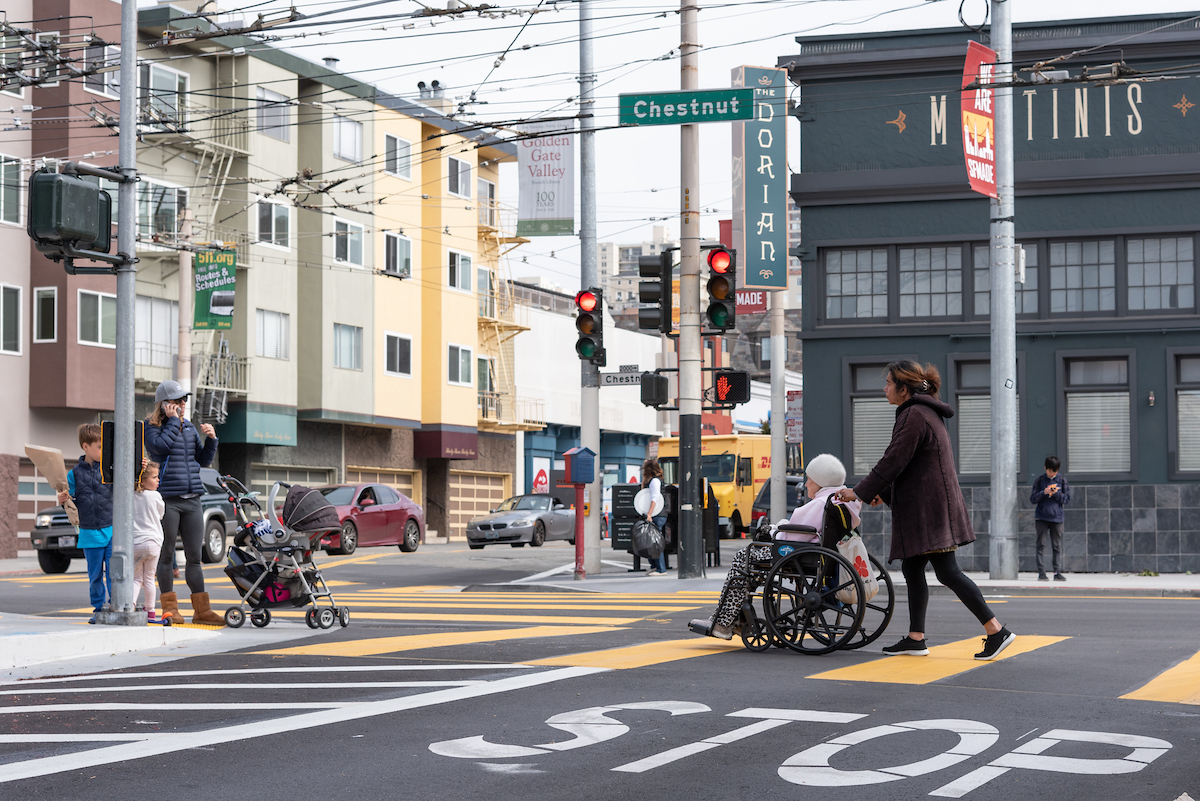
Since 2013, ride-hail companies, also known as Transportation Network Companies or TNCs, have become increasingly visible on San Francisco’s streets. In the area of disability access and TNCs, while some individuals have reported increased mobility and independence because of TNCs, wheelchair users have largely been unable to use the service. Ride hailing apps generally did not offer wheelchair accessible vehicles—nor were they required to do so by the CPUC.
While the SFMTA and our sister agency, the San Francisco County Transportation Authority (SFCTA) do not have the authority to regulate these services—a job entrusted statewide to the California Public Utilities Commission (CPUC)—we have worked together to pay close attention to the impact they have on our transportation network and shaped our areas of studies, policies, and programs accordingly. For example, over the years, the City has documented how well these services do or do not meet San Francisco’s Guiding Principles for Emerging Mobility Services, helping to shape policy and recommendations around our congestion and disability access goals.
A move in the right direction: the TNC Access for All Act
For this reason, San Francisco was proud to support the TNC Access for All Act, signed into law by then-Governor Jerry Brown in 2018. The bill requires the CPUC to develop regulations relating to accessibility for persons with disabilities, including wheelchair users who need a wheelchair accessible vehicle (WAV). The bill also created a financial incentive for TNCs to increase accessibility by imposing a per-trip fee on all TNC rides in the state. The funds from this fee are then used to reimburse ride hailing companies for their expenses if they demonstrate they are improving access to WAVs on their platforms. If a company does not meet the requirements established for reimbursement, or if they do not provide WAV services in a county at all, the collected fees are deposited into an “Access Fund” for other eligible providers to help provide on-demand WAV services in that area instead.
Since July 2019, TNCs have collected a 10-cent fee for every non-WAV trip in California. While the CPUC has not yet distributed funds to non-TNC providers as part of the Access Fund, we have started to receive data on how TNCs like Uber and Lyft are trying to improve WAV services in the few counties for which information has been reported.
So, how do we know if wheelchair accessible TNC services are improving in San Francisco and throughout the state?
For TNCs to keep the fees they are collecting to pay for WAV services, companies like Uber and Lyft must demonstrate to the CPUC that their WAV services are meeting certain quarterly performance requirements. The CPUC requires TNCs seeking reimbursement to submit reports, called “Advice Letters,” to the CPUC and anyone registered on the CPUC’s official “service list.” These reports are a series of PDF and Excel files that include aggregated data by county on service aspects like number of trip requests and rate of fulfillment, hours of service provided, response times (the time between requesting a trip and receiving a ride), expenses incurred, complaints received, and outreach performed.
All of the information provided in these Advice Letters is incredibly valuable for understanding the state of wheelchair accessible TNC service throughout California. However, the way CPUC requires the TNCs to file the information to a small group and in a difficult-to-read format has limited the utility of the data. Until now! In 2021, the SFMTA and SFCTA were chosen to participate in the San Francisco Office of Civic Innovation’s Civic Bridge Program. Through this program, we were matched with pro-bono partner ZS Associates to develop publicly available data dashboards to display key pieces of the data submitted by TNCs.
The dashboards, which are now hosted on our website, feature the following tabs: Total Trips Requested and Completed, Trips Requested and Completed by Operator, Average Number of WAVs Available Each Hour, Trips Requested – Completed and Cancelled, Response Time, TNC Expenses, and TNC Complaints.
The Trips tabs show requested and completed WAV trips, as well as cancellations. The Response Time tab includes a breakdown of the average time between passenger request and driver arrival. The Expenses tab includes program expenditures by spending category (and note that “Partnership Costs” include most of the direct costs of providing WAV service—usually the amount paid to a contractor who is providing WAV trips for the TNC. “Operational Costs” are primarily overhead). Finally, the Complaints tab categorizes the complaints reported about the TNCs’ WAV service. Each tab can be viewed by vendor (currently Lyft, Uber, or Nomad), county, year, and quarter.
We are pleased to make this important reporting data more publicly accessible, and encourage you to explore the dashboards.
Published January 11, 2022 at 02:51AM
https://ift.tt/3K93zzk
Comments
Post a Comment