Muni’s Equity Toolkit Helps Essential Employees Get to Work

Muni’s Equity Toolkit Helps Essential Employees Get to Work
By Mariana Maguire

The latest data from SFMTA’s new Equity Toolkit shows that Muni service changes are helping people in neighborhoods identified by our Muni Service Equity Strategy access more jobs and support the city’s recovery.  

In winter 2020, we launched the SFMTA Equity Toolkit to understand how service decisions are affecting neighborhoods where there is likely a high prevalence of essential workers who rely predominantly on Muni to get to their essential jobs. Our goal is to make better service decisions based on the trends and impacts we see in the Equity Toolkit.  

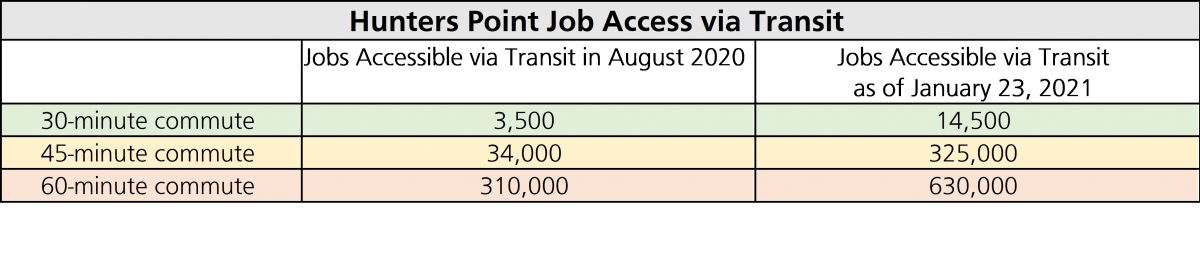
Recently, the greatest increases in access to jobs via Muni have been in Hunters Point and Western Addition. The Hunters Point neighborhood saw the largest gains from the addition of the 15 Bayview-Hunters Point Express, as demonstrated in the table below. Thanks to the return of key Muni lines and increased frequencies on connector routes, Inner Mission, Tenderloin, Oceanview-Ingleside and Treasure Island have also seen increased access to jobs via Muni.  
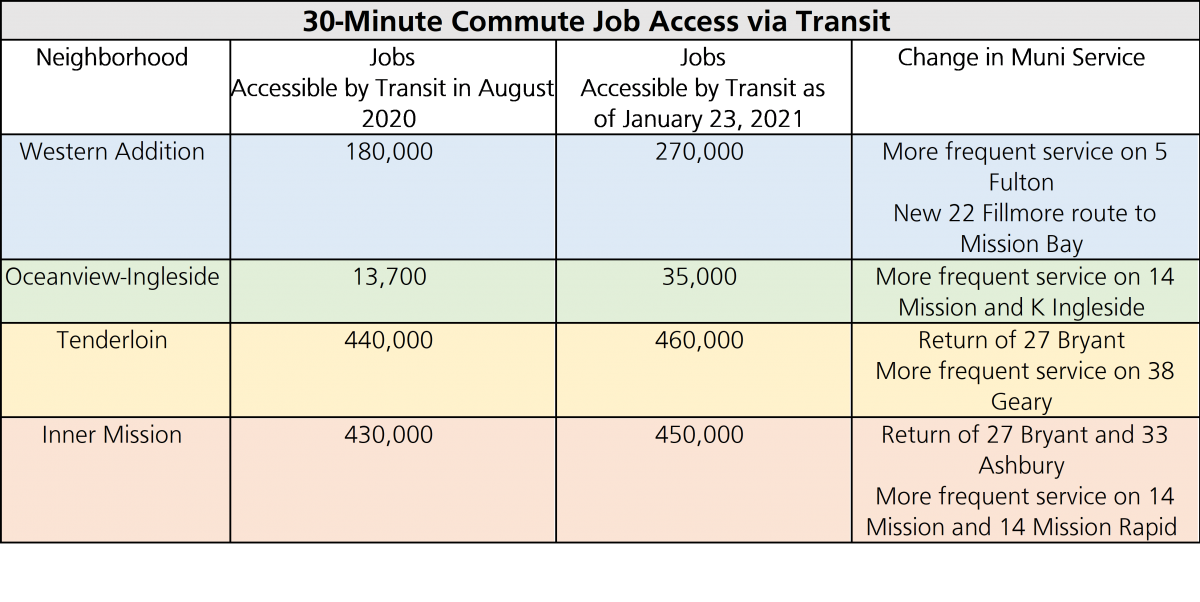
Table title: "30-Minute Commute Job Access via Transit" First row, left to right: column 1 is "Neighborhood", column 2 is "Jobs Accessible by Transit in August 2020", column 3 is "Jobs Accessible by Transit as of January 23, 2021", column 4 is "Change in Muni Service" Second row, left to right: column 1 is "Western Addition", column 2 is "180,000", column 3 is "270,000", column 4 is "More frequent service on 5 Fulton, New 22 Fillmore route to Mission Bay" Third row, left to right: column 1 is "Oceanview-Ingleside", column 2 is "13,700", column 3 is "35,000", column 4 is "More frequent service on 14 Mission and K Ingleside" Fourth row, left to right: column 1 is "Tenderloin", column 2 is "440,000", column 3 is "460,000", column 4 is "Return of 27 Bryant, More frequent service on 38 Geary" Fifth row, left to right: column 1 is "Inner Mission" column 2 is "430,000", column 3 is "450,000", column 4 is "Return of 27 Bryant and 33 Ashbury, More frequent service on 14 Mission and 14 Mission Rapid"

Table title: Hunters Point Job Access via Transit First row, left to right: column 1 is blank, column 2 is "Jobs Accessible via Transit in August 2020", column 3 is "Jobs Accessible via Transit as of January 23, 2021" Second row, left to right: column 1 is "30-minute commute", column 2 is "3,500", column 3 is "14,50o" Third row, left to right: column 1 is "45-minute commute", column 2 is "34,000", column 3 is "325,000" Fourth row, left to right: column 1 is "60-minute commute", column 2 is "310,000", column 3 is "630,000"

Lessons Learned 

The Equity Toolkit also shows some decreases in job access via transit in other neighborhoods identified by the Muni Service Equity Strategy. This reflects the Toolkit’s methodology and/or the impacts of service changes and helps us to understand where we need to make improvements in our data collection, transit service or both. 

Bayview job access increased for commutes of 45 and 60-minutes, but decreased 11% for 30-minute commutes. How can that be? The answer is that the T Third bus substitution was replaced with rail service in December 2020, which makes different and fewer stops than the bus within a 30-minute time period. Overall, Bayview residents are still able to access more jobs now than in August 2020 – roughly 644,500 now compared to 624,000 then, a 3% increase. 

In addition, we rely on fixed points of reference, such as the Bayview Opera House, to gather data and Bayview is a large neighborhood. We learned that using one community landmark for this area is not enough, so we will be adding additional landmarks in future analyses to more accurately capture service change impacts. 

In Visitacion Valley we see decreases in job access via transit across the board. Like in the Bayview, we determined that the issue is both methodology and service. When we redistributed buses from the 8 Bayshore to 8AX to respond to changes in ridership, the community landmark (John King Senior Community) we were using to track the data only showed us the decrease from the 8 Bayshore, not the increase from the 8AX. 

By comparison, more affluent areas show very low to no increases in job access via transit. This reflects our decision to prioritize resources on Muni service for essential workers and essential travel, especially for communities with the fewest options during this unprecedented pandemic. More affluent neighborhoods have more transportation alternatives readily available and more people who are able to work from home. 

These findings give us insights we didn’t have before and help us think about service in new ways. As we learn from the Equity Toolkit we will continue to refine it and make it more detailed by adding more reference points for our data analysis.  

As San Francisco gradually reopens and we continue to add back Muni service, we will also continue to evaluate the impacts through our Equity Toolkit and work to use these insights to inform service adjustments that support our city’s economic recovery. 

Read more about changes to our network on the SFMTA’s Transportation Recovery Plan webpage


Published March 30, 2021 at 11:03PM
https://ift.tt/2PkupwH

Comments

Popular posts from this blog

Help Make Muni Safe for Everyone

Help Make Muni Safe for Everyone By Mariana Maguire New Muni “no harassment” symbol The safety of our customers and staff is a top priority for the SFMTA. That is why we are launching MuniSafe – a campaign to increase reporting of gender-based harassment through recently expanded incident reporting options. If you experience or witness an incident, help us make MuniSafe by reporting it using the Muni Feedback form at SFMTA.com/MuniFeedback, the 311 mobile app or by calling 311. Non-English speakers should call 311 for language-assisted reporting. Gender-based harassment takes many forms, affects many people and is absolutely not tolerated on Muni. Survivors should report incidents to the San Francisco Police Department if they feel comfortable doing so. By also reporting incidents directly to the SFMTA, you will help us track events that occur in our system so we can build better safety responses and direct resources to reduce gender-based harassment. New car cards that will be...

L Taraval Improvement Project “Segment B” Geared Up for Early 2022

L Taraval Improvement Project “Segment B” Geared Up for Early 2022 By Stephen Chun Over the summer, we shared the good news that the  first segment  of the  L Taraval Improvement Project  was  completed on schedule and within budget.  A notice to proceed for the next phase of work, Segment B was issued last week to NTK Construction. Project staff is now gearing up for work slated to begin in January 2022.   What is the L Taraval Improvement Project?  The L Taraval Improvement Project is a multi-agency collaboration partnered with the San Francisco Public Utilities Commission and the Department of Public Works to improve and upgrade the aging infrastructure. The project will make pedestrian crossing safer, increase accessibility, improve transit reliability, rehabilitate water and sewer infrastructure, enhance landscaping and replace road pavement along the L Taraval line....

Do exercise to keep fit

Health is wealth